The two scorecards below look familiar to many IELTS and TOEFL test takers. Listening and reading are often stronger, while writing and speaking become the main bottlenecks.
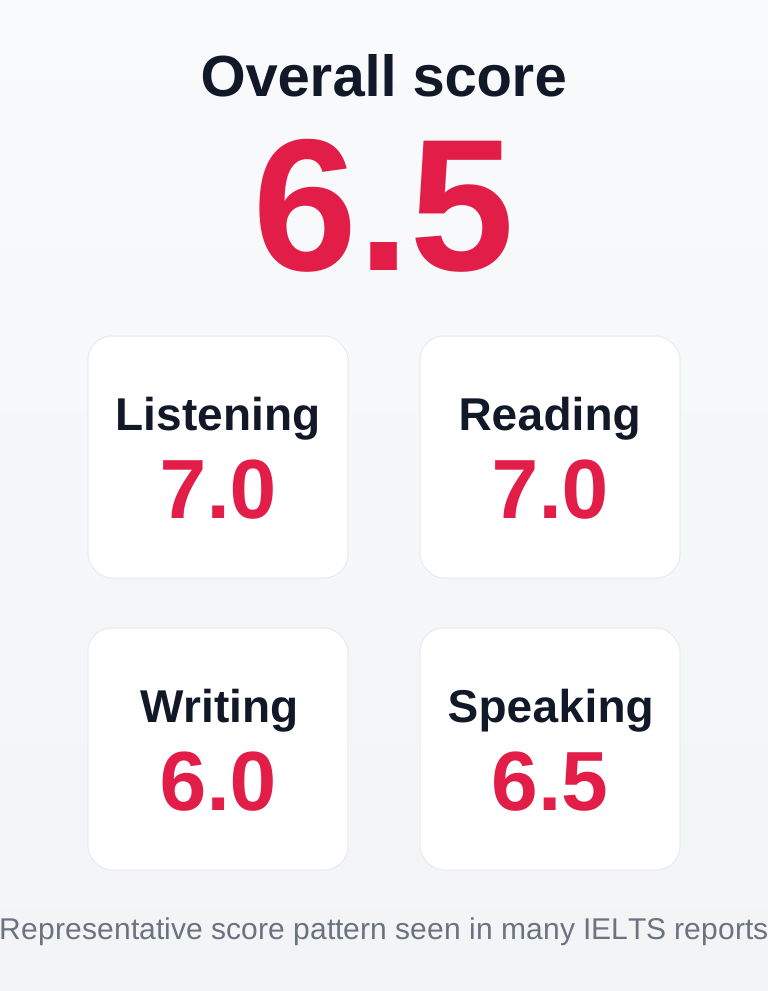
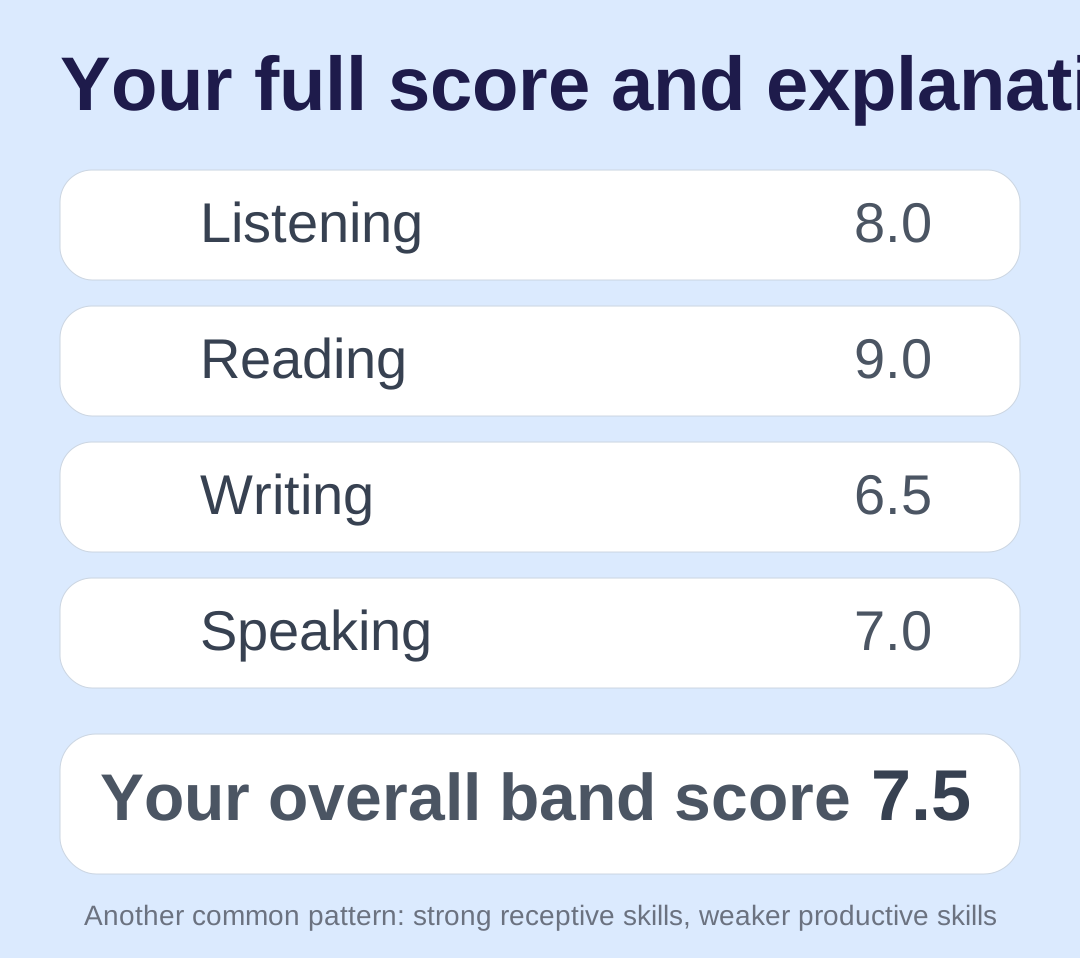
If this pattern feels personal, you are not alone. Across student communities, prep groups, and score reports, the gap appears again and again: reading and listening improve faster, while writing and speaking move slowly. The reason is not talent. The reason is feedback design.
Why Reading and Listening Improve Faster
Reading and listening are scored with standardized answers. You can check exactly what is right, what is wrong, and why your score changed. That creates a clean learning loop:
- You practice a set.
- You compare with an answer key.
- You identify error patterns.
- You target those patterns in the next set.
This loop is fast, objective, and repeatable. In exam prep terms, it is highly scalable. You can do it daily without extra cost, and you can measure progress almost immediately.
Why Writing and Speaking Stay Stuck
Writing and speaking are different. They are judged with rubrics and human interpretation. IELTS and TOEFL examiners evaluate task response, coherence, lexical range, grammar, fluency, pronunciation, and delivery quality. These are meaningful criteria, but they are also more subjective than multiple-choice keys.
For most learners, the problem is not only "I do not know the rubric." The deeper issue is "I do not get enough specific feedback, often enough, to change my habits."
- You can write ten essays but still not know which sentence-level habits lower your band.
- You can do speaking practice but still not know why answers sound weak under timing pressure.
- You can feel busy but get little measurable score movement.
In short, productive skills fail not because students do not practice, but because practice happens without a consistent feedback engine.
The Human-Only Feedback Bottleneck
Human teachers and examiners are valuable, but a human-only model creates constraints:
- High cost per correction or mock interview.
- Scheduling friction and time-zone issues.
- Limited frequency, which slows iteration speed.
- Inconsistent feedback detail when time is short.
This is why many students do one or two paid corrections, then stop. They cannot afford the volume needed for real score jumps.
How AI Changes the Equation
The core advantage of AI in language prep is not replacing people. It is increasing feedback frequency to a level that was previously impractical.
Writing Better lets users get unlimited AI essay correction for one month at roughly the price of a single human correction session. That means students can submit drafts, revise, resubmit, and build a true iteration loop without worrying about per-essay billing.
Speaking Better offers a free mock speaking session every week, and each extra session is priced at around one-tenth of a typical human mock test. This directly removes the two barriers that slow speaking growth: cost and scheduling.
What This Means for IELTS and TOEFL Outcomes
When feedback becomes frequent, affordable, and immediate, students can train productive skills the same way they train receptive skills:
- Practice under exam-like constraints.
- Get fast diagnosis on specific weaknesses.
- Apply revisions while memory is still fresh.
- Repeat the cycle multiple times per week.
Over time, this turns writing and speaking from "mystery sections" into trainable systems. The score gap with reading and listening narrows because the learning loop finally catches up.
A Simple Weekly Plan You Can Start Now
- Write 3-5 essays per week and revise at least one draft twice.
- Do 2-3 speaking simulations with strict time limits.
- Track recurring issues: idea development, cohesion, grammar, pacing, and pronunciation.
- Review one focused weakness each week instead of fixing everything at once.
The key is consistency, not heroic effort. Better loops beat longer study hours.
Final Takeaway
Low writing and speaking scores in IELTS and TOEFL are common because these sections have historically had weak feedback accessibility, not because students are incapable. Reading and listening improved first because they had answer keys. Now, with AI-powered systems like Writing Better and Speaking Better, writing and speaking can finally get their own scalable feedback loop.
If your profile looks like the examples above, treat it as a normal starting point, not a fixed ceiling. With the right feedback frequency, productive scores can move faster than most students expect.
Published on March 14, 2026